

 English
 Français
 Deutsch
 Italiano
 Português
 Русский
 Español
 简体中文
简体中文 日本語
日本語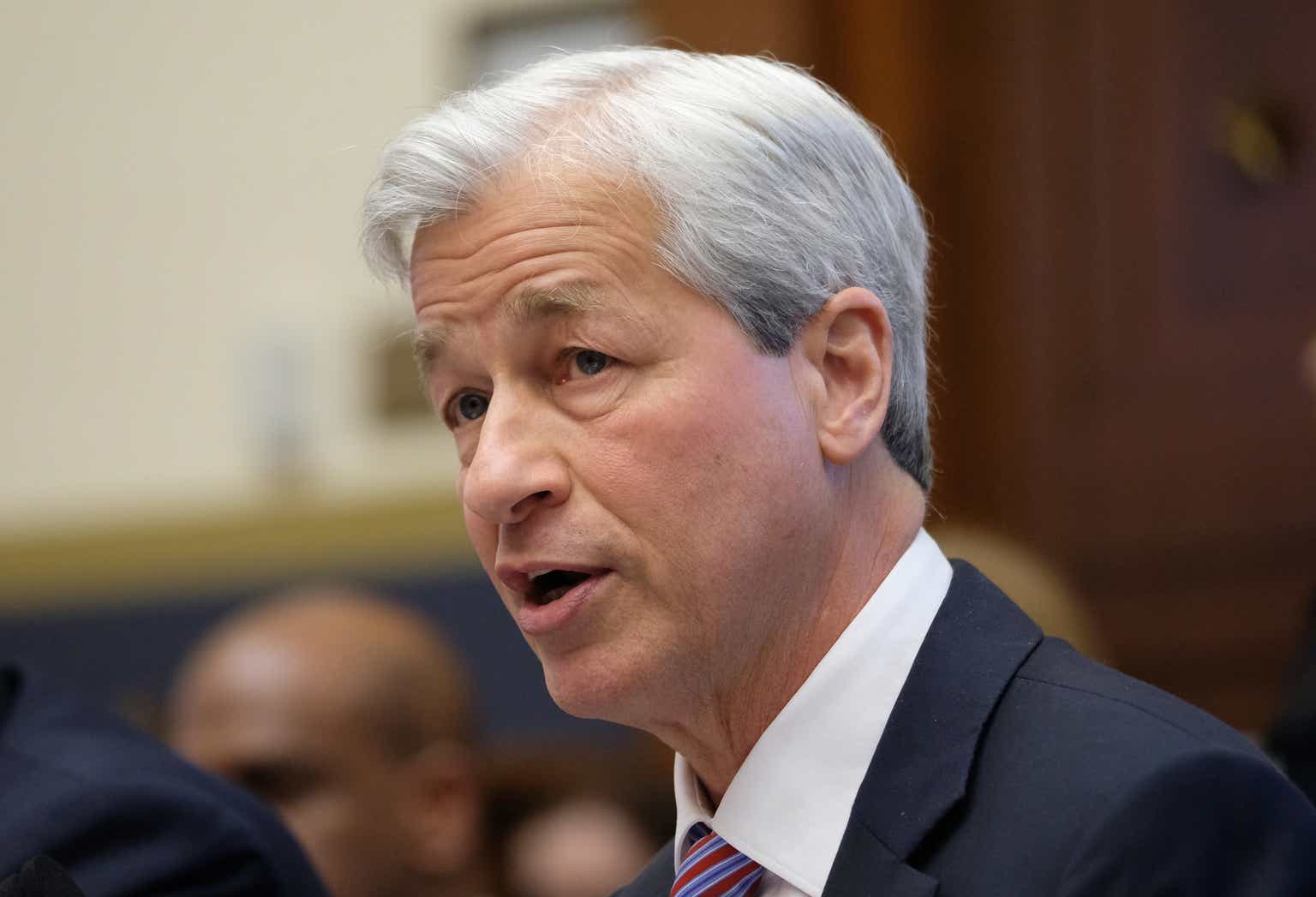

JPMorgan Chase (JPM) CEO Jamie Dimon recently rattled markets (SPY) with a stark warning about the potential for interest rates to rise to 7%. Markets – particularly those sectors that are most interest rate sensitive such as precious metals (GLD)(SLV), utilities (XLU), and REITs (VNQ) – have already sold off aggressively in response to a rapid rise in long-term interest rates in recent weeks. However, if interest rates were to reach the 7% level – 150-250 basis points above current levels – that would likely mean that the bloodbath has only just begun.
In this article, we discuss the prospects of 7% interest rates and their ramifications for stocks and the economy, why we do not think this scenario is likely, and then share our approach to preparing our portfolio for these stormy seas in which we find ourselves.
Reasons For & Implications Of 7% Interest Rates
Interest rates are soaring due primarily to the fact that government spending is at its highest levels in history outside of wartime. As a result, the government needs to borrow more, thereby increasing the supply of debt in the bond markets, thereby pushing interest rates higher.
Another factor is rising geopolitical tensions, specifically Russia’s war on Ukraine and growing tensions between the world’s two largest economies (the United States and China). As a result, many leading sovereign holders of U.S. treasuries – particularly China – are dumping their holdings of U.S. debt, further increasing the supply of debt in the markets.
Finally, persistently high inflation has caused the Federal Reserve to aggressively hike short-term interest rates while also ceasing its bond-buying program and instead implementing quantitative tightening by letting its balance sheet shrink as its current bond holdings mature. This leads to lower demand for debt even as the supply of debt is soaring.
Given that there appears to be no near-term catalyst for government spending to steeply decline nor for China to stop dumping its treasuries, Mr. Dimon believes that Americans need to prepare for a surge in interest rates. This could have negative effects on consumer spending and economic growth, in turn causing a ripple effect across various investment strategies, including dividend growth investing and high-yield investing. In the worst-case scenario, the economy could face stagflation, characterized by low growth and high interest rates, which would bode very poorly for many interest-rate-sensitive companies.
While most analysts anticipate a final interest rate hike of 0.25 percentage points by the Federal Reserve in November – reaching a range of 5.50%-5.75% – Mr. Dimon seems to think that the central bank might continue raising rates by an additional 1.5 percentage points, resulting in a federal funds rate not seen since December 1990. Such a dramatic increase in interest rates could have significant ramifications on the economy, dampening consumer spending and business investment by increasing the cost of capital, likely pushing the economy into a recession.
Why Rates Are Unlikely To Reach 7%
While there is a chance that Mr. Dimon is correct, we believe that the odds are overwhelmingly in favor of interest rates peaking at a level well below 7% and likely heading lower than current levels in the next few years if not next year already.
The biggest reason for this is simply because a recession is becoming increasingly likely in the United States, despite many having optimistic visions of the Fed achieving a “soft landing.” History has shown that soft-landing predictions often precede economic downturns since economists tend to extrapolate current trends and assume linear growth in the economy. However, recessions are inherently non-linear events that are challenging to predict accurately.
Moreover, while some economists point to robust household spending as an indicator that the economy remains on solid footing and is unlikely to experience a recession, history has shown that consumer spending can remain strong even before a recession. Additionally, savings accumulated during the pandemic are running out, and credit card delinquency rates have increased, signaling potential troubles ahead.
Moreover, the full effects of the Federal Reserve’s interest rate hikes, totaling 525 basis points since early 2022, are yet to be fully felt in the economy. Given that these hikes typically have a lag of 18 to 24 months before their effects are felt in the labor market, the current tight labor market conditions we are seeing could be misleading.
There are also several other potential catalysts for tipping the economy into recession, including the recent resumption of student loan repayments, higher oil prices, a still inverted yield curve, and economic slowdowns in major U.S. trading partners like China and Europe, all of which could significantly impact GDP growth.
Finally, the rapid rise in interest rates – combined with more conservative lending practices at banks in the wake of the banking crisis this Spring – is likely producing dramatic declines in business investment and consumer spending and therefore weakening the jobs market, which in turn is likely beginning to weigh meaningfully on overall economic activity.
What this all means is that once the economy tips into recession, the Federal Reserve will likely feel compelled to intervene and prop up the economy by cutting interest rates once again.
Other reasons why we remain optimistic that interest rates are at near peak levels and are likely to decline meaningfully in the near future include:
- Artificial intelligence is likely going to provide meaningful deflationary impacts on the economy in the coming years.
- The upcoming 2024 election will likely put political pressure on the Federal Reserve to stabilize markets and the economy.
- The large deficits that the U.S. Government is facing will likely put additional political pressure on the Federal Reserve to begin buying treasuries on the open market again in order to suppress long-term interest rates.
- A wall of trillions of dollars in corporate and real estate debt that was mostly underwritten when interest rates were far lower than where they are today is coming due in the next few years. This will likely force the Federal Reserve to either slash interest rates or risk plunging the economy into another financial crisis.
How Should Investors Prepare?
How should investors prepare their portfolios to survive in a higher longer interest rate environment while still positioning themselves to benefit from the likely event where interest rates decline meaningfully in the coming months and years?
We believe that investing in interest-rate-sensitive businesses that have very strong balance sheets is arguably the best way to approach this dilemma. This is because these businesses will benefit tremendously from falling interest rates on both a fundamental and valuation basis but still be able to survive through an extended period of elevated interest rates.
Two stocks that come immediately to mind are Enterprise Products Partners (EPD) and Brookfield Asset Management (BAM).
EPD is a midstream energy infrastructure business that owns very high-quality assets that provide a stable stream of cash flows through all kinds of macroeconomic and energy industry conditions. As such, it is well positioned to weather an economic downturn that may result from interest rates soaring so high so quickly.
BAM – as an alternative asset manager – is similarly well positioned. The vast majority of its assets under management are either permanent or long-dated and its clientele is very sticky. It generates very stable, annuity-like fee-based earnings from its investment funds and products, making its earnings stream quite stable even during periods of economic turmoil when its fundraising may slow down.
Moreover, both companies have very little dependence on capital markets as BAM has no debt and several billion dollars in cash on its balance sheet and EPD has a lot of liquidity, very low leverage, and a very lengthy weighted average term to maturity on its borrowings. Moreover, it has very little exposure to floating rate debt. Furthermore, both BAM and EPD boast A- credit ratings from S&P, and both companies generate significant free cash flow, further boosting their financial power in the face of rapidly rising interest rates and increasingly constrained capital markets.
While both businesses are well-positioned to survive during a period of elevated interest rates, they both undoubtedly benefit from falling interest rates as well. This is because both generate very stable, long-dated cash flow streams that are bond-like in nature. Therefore, the lower interest rates go, the greater the relative value of EPD’s and BAM’s cash flow streams become. Moreover, EPD still does occasionally choose to access bond markets to refinance its debt maturities (though it could pay them off with retained cash flow if it chose to), so low interest rates will boost its returns on equity. BAM, meanwhile, grows by raising funds for its investment funds and products. The lower interest rates go, the more attractive its investment funds and products look by comparison.
Investor Takeaway
Rapidly rising interest rates have been the dominant theme for the stock market since early 2022. Now, Jamie Dimon sees the potential for interest rates to soar still higher. While anything is possible, we believe this is an unlikely scenario. Instead, we expect the Federal Reserve to intervene and push interest rates lower sometime over the next twelve months.
As a result, we think that now is the time to be scooping up inexpensively priced, high-quality interest rate-sensitive investments. In particular, we think that interest rate-sensitive investments that have fortress balance sheets and recession-resistant business models provide the best risk-reward at the moment. That way, even if interest rates do soar like Mr. Dimon fears they may, investors should be able to sleep well at night knowing that their investments are well-positioned to weather the storm and emerge on the other side in a strong position.
Read the full article here