

 English
 Français
 Deutsch
 Italiano
 Português
 Русский
 Español
 简体中文
简体中文 日本語
日本語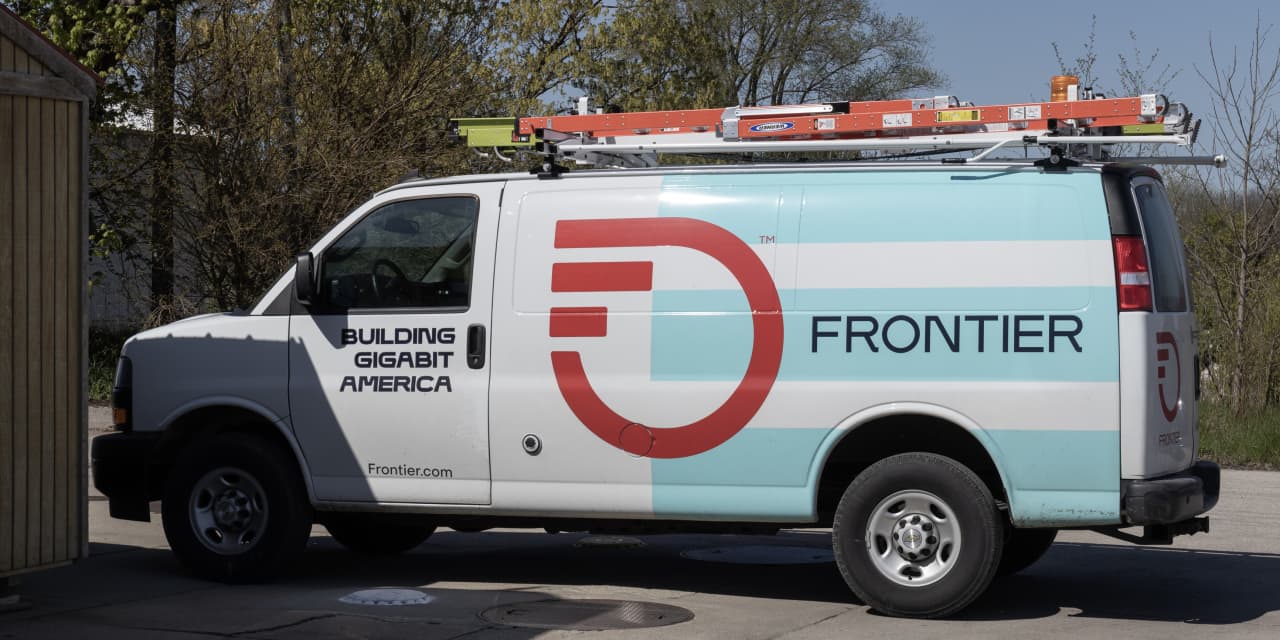

Frontier Communications has long been an undervalued stock. It got a positive catalyst last week in the form of Jana Partners, with the activist investor calling for a sale of the of internet, television, and phone provider.
Frontier (ticker: FYBR) has been transitioning from an aging network built on copper wires to a modern one that reaches customers over fiber-optic cable. The process has been slow and requires billions of dollars of investment before generating positive returns. Higher interest rates and a stock-market rout have only raised the cost of financing that transition.
Once running, however, fiber-based internet costs less to operate. It also performs better than older technologies, and Frontier can charge more. Frontier says that 85% of its footprint has only one or no fiber competitor, which will boost adoption.
Nonetheless, investors have not been eager to go along for the ride. Frontier emerged from bankruptcy in May 2021 at $30 per share, and the stock halved in value by summer 2023. Barron’s recommended buying Frontier shares in July at around $14, versus a recent $18.80 after a 13% rally last week. Investors aren’t giving Frontier credit for the value of its to-be-completed fiber network, but Wall Street analysts have an average price target of $32.36, according to FactSet, implying about 75% upside.
Jana’s Scott Ostfeld pitched Frontier stock at a conference last week, arguing that the company’s true value and investment needs would be better recognized and served in private hands and that the company should put itself up for sale. Potential buyers could be a larger and better-capitalized telecom company or a private-equity firm.
Jana declined to comment.
Frontier said in a statement, “Our Board of Directors and management team are focused on driving long-term value for our shareholders, employees, and customers and continue to take actions that enable us to deliver on this objective.”
Significantly, Ostfeld said that Jana had partnered with a “major communications company” on its investment in Frontier, suggesting that there’s already acquisition interest. It’s unlikely to be cable giants
Comcast
(CMCSA) or
Charter Communications
(CHTR) given likely regulatory challenges.
AT&T
(T) and
Verizon Communications
(VZ) have fiber networks of their own, and are in debt-paydown, not acquisition, modes.
By process of elimination, that leaves T-Mobile US (TMUS) as Jana’s most likely partner in investing in Frontier. The wireless company is starting to see in earnest the financial benefits of its Sprint acquisition, which closed in 2020. Earnings and free cash flow are ramping up, and leverage is declining.
T-Mobile didn’t respond to requests for comment.
Frontier’s enterprise value of around $13 billion is barely 5% of T-Mobile’s—or roughly equivalent to this year’s free cash flow.
T-Mobile has been sniffing around fiber investments already, in the name of “convergence”—the ability to offer bundled wireless and home internet service. Adding Frontier would significantly accelerate T-Mobile’s fiber efforts, but also add a shrinking copper-based business.
Fiber assets have been hot among PE buyers as well. Funds affiliated with Apollo Global Management (APO) acquired Lumen Technologies’ (LUMN) copper and fiber network in 20 states for $7.5 billion. Last week, Searchlight Capital Partners and Canadian institutional investor British Columbia Investment Management partnered to take Consolidated Communications Holdings (CNSL) private for about $3.1 billion.
Frontier has significant debt on its balance sheet, but also owns a lot of hard telecom assets that it or a potential buyer can borrow against. Large shareholders would also have to be on board with any potential transaction, and Frontier’s top two are Ares Management (ARES) and Cerberus Capital Management, with stakes of 16% and10%, respectively.
Ares declined to comment. Cerberus did not respond to a request for comment.
“Regardless of whether a deal is consummated, the news reinforces our view that Frontier’s existing fiber asset value is undervalued by the current stock price,” says Wolfe Research’s Peter Supino. “Signs of strategic interest should place a floor under the valuation.” He rates Frontier stock at Outperform with a $27 price target.
There are real hurdles to a deal, and bidders might not offer a price that Frontier insiders think it’s worth. But testing the market can’t hurt.
Corrections & Amplifications
Frontier emerged from bankruptcy in 2021. A previous version of this article incorrectly said it emerged in 2020.
Write to Nicholas Jasinski at [email protected]
Read the full article here