


 English
 Français
 Deutsch
 Italiano
 Português
 Русский
 Español
 简体中文
简体中文 日本語
日本語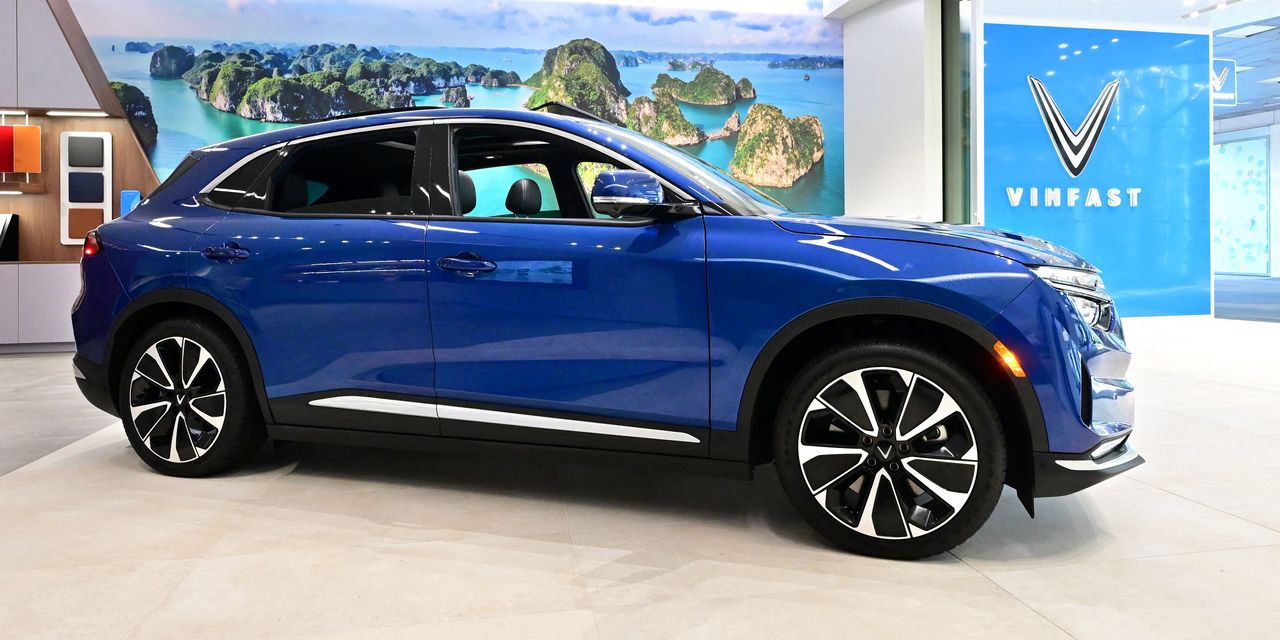

Battery-range data from electric vehicle start-up
VinFast Auto
illustrates a problem for investors and drivers seeking to understand a critical component of these cars. The data also illustrate a potential problem for one of VinFast’s models.
Take the VF 8 SUV, of which VinFast sold 850 in the U.S. during the first half of the year. The company lists a battery range of some 260 miles on some of its Eco trim model’s specification sheets. The Environmental Protection Agency puts the range at 207 miles. The EPA tested the City Edition of the vehicle. VinFast makes other versions of the car.
As for the 260 versus 207, the difference in numbers has a simple explanation. The 260-mile range is based on the Worldwide Harmonised Light Vehicle Test Procedure, or WLTP. To determine the range, testers essentially drive an EV at 35 miles an hour on a cool day until it runs out of juice and measure the results. WLTP is thought of as a European standard.
The EPA estimate, on the other hand, incorporates factors such as air-conditioning usage on hot days and highway vs. city driving. That’s the U.S. standard.
VinFast does list the EPA range on its website and its U.S. spec sheets. That’s not the issue. The problem for the company is that a 207-mile range is below average.
The average EPA range for 15 popular EV models is 280 miles per full charge, according to Barron’s analysis. That’s the range that car buyers would probably expect if they started to do comparison shopping between models.
The VinFast VF 9, a full-size SUV, gets 330 miles of range, according to the EPA’s tally. That’s a solid number that compares favorably with other EV models.
The reason for the difference between VinFast’s models isn’t a mystery. The VF 8 City Edition’s battery pack has 82 kilowatt-hours, or kWh, of juice. The VF 9 has a 123 kWh battery pack. More battery power, more range.
The VF 8 City Edition works out to about 2.4 miles per kWh. The longer-range Eco and Plus VF 8s have a larger battery pack that gets roughly 3 miler per kWh and the VF 9 comes in at 2.7 miles per kWh. The better efficiency can be explained by weight; the VF 9 likely weighs close to 6,000 pounds based on comparable EVs, while the VF 8 likely weighs about 5,500 pounds.
VinFast didn’t respond to a request for comment about weights.
Differing weights make it difficult to judge EVs based on range per kWh. A Rolls-Royce Specter gets 2.5 miles of range per kWh, but that car weighs 6,600 pounds. A
Tesla
(TSLA) Model 3 weighs about 4,000 pounds. It gets 3.8 miles per kWh.
We plotted miles per kWh against weight for the 15 cars used in our analysis. Some automakers’ EVs fell above the trend line, implying they are more efficient, and some fell below.
The grouping close to the trendline shows there really isn’t much differentiation. A battery is a battery, and most companies can design a reasonably efficient car based on this analysis.
There are ways automakers can improve these numbers, but they come at a cost. For example, battery chemistries with more nickel or cobalt have higher power density but are more expensive.
The takeaway for U.S. car buyers is to look at the EPA range. It should be close enough to their actual experience. At a minimum, buyers should compare apples to apples. Don’t compare WLTP numbers to EPA ranges.
Investors have a little more work to do. They can concern themselves with ranges, which is how consumers will compare models. But that’s just one data point, and a noisy one. Instead, pay attention to gross-profit margins. That figure is a much better indicator of the underlying business because it incorporates everything from battery choices, car design, and manufacturability.
VinFast is new and doesn’t manufacture enough vehicles to achieve the scale needed for consistent profits. The company’s gross-profit margin in the quarter reported in the company’s registration statement came in at roughly minus 200%. Tesla’s gross-profit margin in the second quarter was closer to 20%.
At almost $37 a share, VinFast is worth some $85 billion, making it one of the most valuable automakers on the planet, despite a lower-than-average range for a model.
VinFast stock is down 5.5% in premarket trading, while
S&P 500
and
Nasdaq Composite
futures are up 0.6% and 1.2%, respectively. Coming into Wednesday trading, VinFast stock is up about 254% since the stock began trading on the Nasdaq under the symbol “VFS” on Aug. 15.
Write to Al Root at [email protected]
Read the full article here