
 English
 Français
 Deutsch
 Italiano
 Português
 Русский
 Español
 简体中文
简体中文 日本語
日本語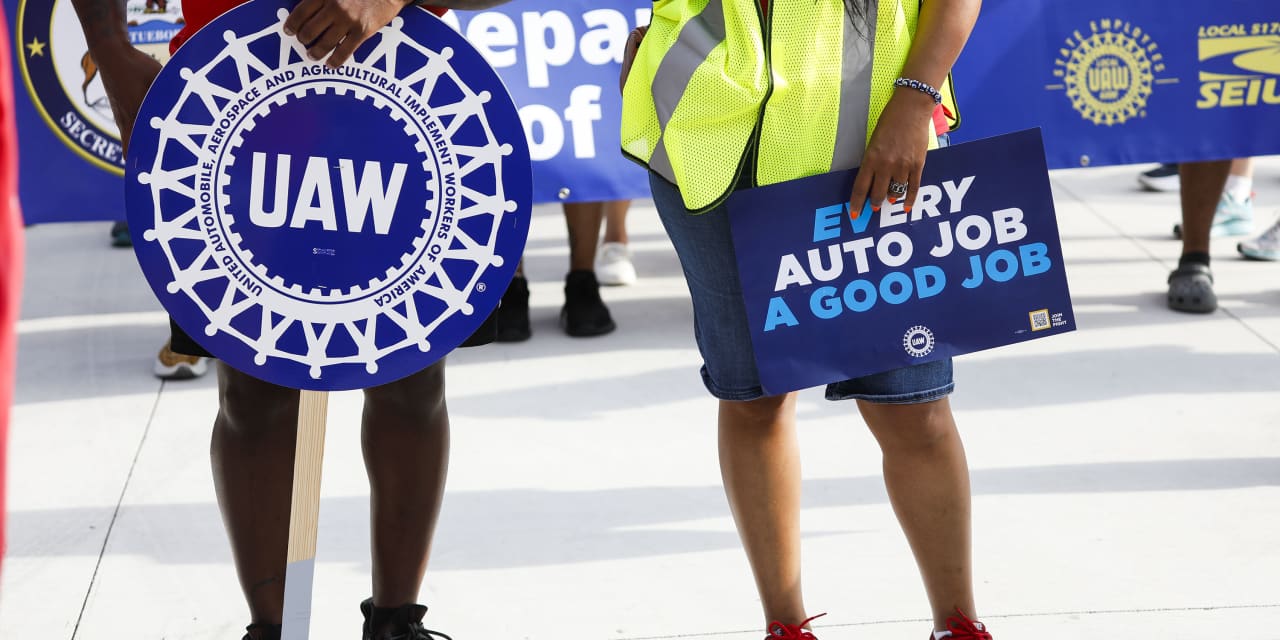

Auto insurance is set to get more expensive if the United Auto Workers simultaneously strike against the Detroit-Three automakers. That isn’t great news for auto-insurance stocks.
All those connections feel a little odd. What does a strike have to do with State Farm? And why aren’t higher prices good for insurers? Investors just need to look at recent history to understand why.
New- and used-car prices are up about 47% compared with prepandemic levels, according to the Bureau of Labor Statistics, which publishes U.S. inflation data. One of the factors in the increase is a lack of supply.
Americans were buying cars at a rate of about 17 million units a year before the pandemic. Now that’s about 15 million units a year. There just aren’t enough cars around to buy. “U.S. light-vehicle dealer inventory ended July at 1.79 million units,” wrote Benchmark analyst Mike Ward in a recent report. “The highest levels since April 2021.” Still, that’s about 1 million units below typical levels.
More-expensive cars means parts and repairs cost more. That has caused auto-insurance to soar by almost 18% year over year in July. Rates are up about 25% from prepandemic levels.
That 47% growth in car prices and 25% increase in insurance rates has wreaked havoc on auto insurers’ profit and loss statements. Operating-profit margins at
Allstate
(ticker: ALL) have gone from about 15% in the fourth quarter of 2019, before Covid-19, to negative 4% in the fourth quarter of 2022. Operating-profit margins in the second quarter of 2023 came in at about negative 8%, according to FactSet.
Insurance price increases have just started to catch up and now the UAW could strike against all three automakers with roots in Detroit,
General Motors
(GM),
Ford Motor
(F), and Chrysler parent
Stellantis
(STLA), if a new labor deal isn’t reached by midnight on Sept. 14.
“A potential UAW strike presents a near-term negative catalyst for auto
insurers,” wrote J.P. Morgan analyst Jimmy Bhullar in a Thursday report. “A strike would disrupt supply chains, cut new vehicle production, and drive an uptick in used car values.”
A strike threatens to start the whole postpandemic cycle again. Rising car prices, which have started to fall in recent months, as supply dwindles away, followed by higher insurance rates, with insurance companies scrambling to cover ever-rising costs.
Bhullar says Allstate and
Progressive
(PGR) are most impacted by a potential strike. He’s still bullish rating both shares at Buy. His Allstate price target is $154 and his Progressive target is $146; on Wednesday those those shares closed at $107.93 and $134.84, respectively.
Strike fears have hit the automaker stocks. GM, Ford, and Stellantis shares are down about 8% on average over the past month, while the
S&P 500
has only slipped about 1%. Insurance stocks don’t appear to have been impacted. Allstate stock is down about 3% but Progressive shares are up about 6% over the past month.
Still, investors have been looking for a rebound in insurer profitability. Allstate stock is down about 14% over the past year. Progressive shares have done better, up 6%, but that lags behind the
Nasdaq Composite
gain of about 18%.
Wall Street sees a turn in margins coming for the auto insurers. Analysts project Allstate will post operating profit margins of 1% and 5% in the third and fourth quarters, respectively. Progressive’s operating-profit margins are forecast to hit 6% in the third quarter and 7% in the fourth quarter of 2023, up from about 2% in the second quarter.
Things can get better for the insurers eventually. Drivers still face higher insurance rates though. Neither group wants to see a strike.
Write to Al Root at [email protected]
Read the full article here