

 English
 Français
 Deutsch
 Italiano
 Português
 Русский
 Español
 简体中文
简体中文 日本語
日本語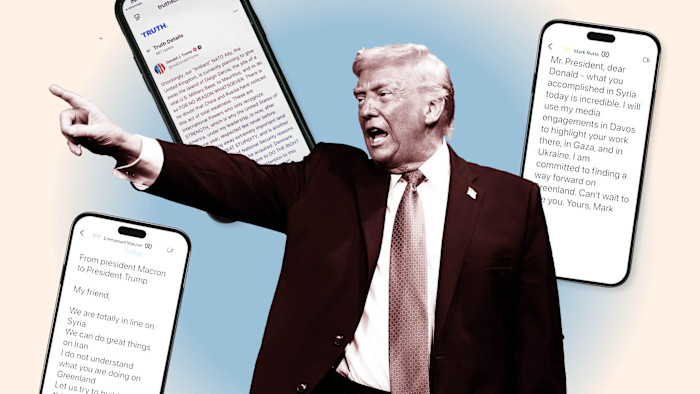

With flattery, coaxing and carefully-couched arguments, European leaders have spent much of the past 12 months desperately trying to win the respect of Donald Trump.
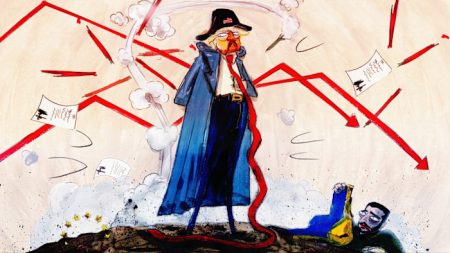
This morning they woke up to see those efforts thrown back in their faces, as the US president switched from threatening the continent to pure mockery.
In the space of an hour, he published screenshots of grovelling text messages from French President Emmanuel Macron and Nato chief Mark Rutte. He accused UK leader Keir Starmer of “GREAT STUPIDITY” and posted an AI-generated image of himself planting a US flag on Greenland.
Nathalie Tocci, director of Rome’s Institute for International Affairs, said Trump was deliberately deploying ridicule as a weapon.
“It’s about submission,” she said. “You make people submit through coercion and through mockery and belittling.”
The volley of insults has compounded the sense of shock and anger in European capitals, already reeling from the impact of a president who has sought to humiliate and weaken Ukraine in its defence against Russia’s invasion, hit the EU with punitive tariffs as part of his global trade war and sought to undermine the continent’s elected governments by supporting far-right populists.
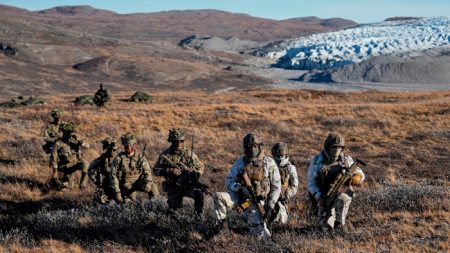
The depth of the transatlantic crisis has deepened significantly in recent weeks since Trump doubled down on his vows to take over Greenland — and threatened to hit eight European nations with tariffs after they sent troops for a military exercise on the Arctic island.
Emily Haber, a former German ambassador to Washington, said Trump was breaking “almost every norm of traditional diplomacy”. “It has reached a new height, especially in the context of Greenland,” she added.
Trump’s use of derision, even against countries that are supposed to be close US allies, is hardly a new phenomenon.
During his first campaign for election and first term in office, he took a notable dislike to the then German chancellor Angela Merkel, calling her policies “insane”, saying she was “ruining” Germany and that the public was “turning against” her.
I told you @TIME Magazine would never pick me as person of the year despite being the big favorite They picked person who is ruining Germany
— Donald J. Trump (@realDonaldTrump) December 9, 2015
He called the then Canadian prime minister Justin Trudeau “very dishonest and weak” during a 2018 summit of G7 leaders, and criticised Britain’s Theresa May for her “very unfortunate” handling of Brexit.
He has renewed his scorn since returning to the White House in January 2025. Trump referred to Spain as a member of the BRICs group of emerging markets, a comment seen by some in Madrid as a deliberate put-down. He mocked global leaders for “kissing my ass” in their efforts to secure trade deals with the US before swingeing tariffs went into effect.
But Trump has upped the ante as he intensifies his campaign to acquire Greenland, which on Monday he linked to his failure to win a Nobel Peace Prize. “I no longer feel an obligation to think purely of Peace,” he said, adding that “the World is not secure unless we have Complete and Total Control of Greenland”.
Last week he lampooned Denmark for its efforts to protect the territory, claiming their defence of the island amounted to “two dog sleds”.
In a fresh barrage posted on his platform Truth Social in the early hours of Tuesday morning in Europe, he shared a doctored photograph showing Starmer, Macron, Rutte and other European leaders looking intently at the US president as he sat alongside a map showing Canada and Venezuela as part of US territory.
Another one depicted him, vice-president JD Vance and Secretary of State Marco Rubio conquering Greenland.
Trump also lashed out at Starmer for his plan to hand over the Chagos Islands to Mauritius and lease a key military base to the US as an “act of great stupidity for “NO REASON WHATSOEVER” — despite Trump’s government previously having given its blessing to the plan.
Hours earlier, when asked about Macron’s reluctance to sign France up to join a US-led “Board of Peace” to monitor Gaza, Trump said that no one wanted the French president “cos he’s going to be out of office very soon”. The US president also threatened tariffs to strong-arm Macron: “What I’ll do is that if they feel hostile I’ll put a 200 per cent tariff on his wines and champagnes.”
Other top US officials have relished joining the barracking, with Treasury secretary Scott Bessent mocking the Europeans and their “dreaded European working group” on how to respond to Trump’s threat of tariffs over Greenland.
Sir Peter Westmacott, a former British ambassador to Washington, said the US president was engaging in gangsterism. “The response to President Macron in particular was mafia shakedown language,” he said.
Europe’s adversaries, meanwhile, have not even tried to hide their glee. Senior Russian official Kirill Dmitriev on Tuesday shared one of Trump’s mocked-up images and described Europe’s “coalition of the willing” on Ukraine as a “Coalition of the Punished”.
Opinion is divided on how best to respond to the onslaught.
France, already one of the most bullish EU states on dealing with Trump, has chosen tit-for-tat.
Using an account set up by the foreign ministry to use memes and satire to push back against Russia and China, it mocked Bessent for his claim that it was better for the US to act now on Greenland because it would get “dragged in” if there were an attack on the island by Russia.
“If there were a fire someday, firefighters would intervene — so better burn the house now,” it said.
But others warned that was the wrong approach.
Haber, the former German diplomat, said Europe should not respond with “muscle, bravado and public outrage or even mockery”. Instead, she said, the continent’s leaders should “take action and be very publicly low-key about it. That’s the only way to achieve an off-ramp.”
Tocci, of the Institute for International Affairs, said ignoring insults was generally the best response — whether dealing with a playground bully or a US president.
But she said it was also important for Europe to build muscle. She said: “If you start practising your kung fu, then, at some point, you punch him in the face.”
Additional reporting by Sarah White in Paris, Barney Jopson in Madrid, Raphael Minder in Warsaw and Richard Milne in Oslo
Read the full article here