

 English
 Français
 Deutsch
 Italiano
 Português
 Русский
 Español
 简体中文
简体中文 日本語
日本語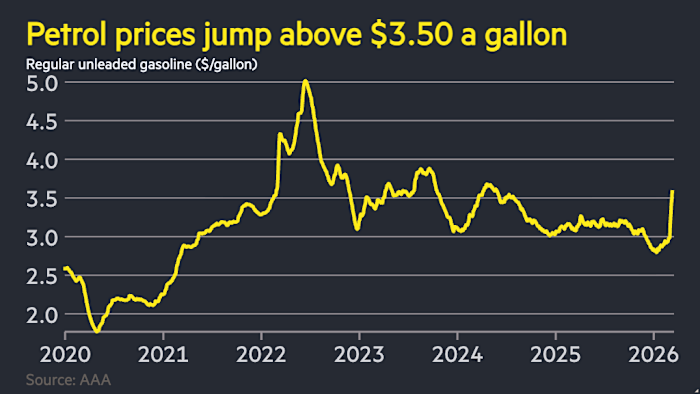

Unlock the White House Watch newsletter for free
Your guide to what Trump’s second term means for Washington, business and the world
Nearly half of Americans hold Donald Trump responsible for the surge in petrol prices triggered by the US war in Iran, according to a new poll which underlines the damage being done to the president’s popularity.
Eight in 10 voters have noticed a change in prices at the pump in recent weeks and 48 per cent blame the president and his administration for the rise, according to a Morning Consult poll carried out this week.
Voters’ ire at Trump dwarfed that directed at other groups: 16 per cent blamed oil and gas companies, 13 per cent pointed to market forces and Opec, while 11 per cent saw it as the fault of former president Joe Biden’s policies.
Petrol prices rose to $3.60 a gallon on Thursday, according to motoring group AAA, up more than 20 per cent since the president launched the war. They are now higher than at any point in his two terms.
The surge past the $3.50 threshold offers voters already concerned about affordability in Trump’s economy another leading inflation indicator — visible up and down the country’s roads.
“Americans fill up 50 times a year. That’s 50 chances to regret their last vote,” said Kevin Book, head of research at ClearView Energy Partners.
Prices at the pump have increased for 12 straight days and analysts expect the rise to continue as long as crude, the fuel’s feedstock, remains elevated by Iran’s near-closure of the Strait of Hormuz, a chokepoint for a fifth of the world’s oil supplies.
The Morning Consult poll found 47 per cent of Americans oppose the US strikes in Iran, with 63 per cent of those worried about rising petrol prices.
The Trump administration has tried to douse the price rally since the president launched the war, saying it would insure oil tankers travelling through the strait or deploy US Navy escorts to protect them from attack.
But western countries’ decision on Wednesday to unleash record amounts of stored oil and comments by Trump that he would release a “little bit” of crude from the US’s own stockpile have failed to halt the price rise.
West Texas Intermediate, the US benchmark, has risen more than a third since the US and Israel first struck Tehran late last month. It settled at $87.25 a barrel on Wednesday, up 4.6 per cent.
Later on Wednesday, energy secretary Chris Wright confirmed the US would release 172mn barrels of oil from its reserves as part of the international effort.
At US petrol stations, the sharp rise in pump prices is stoking frustration among voters.
“I don’t understand why we’re in Iran,” said Alexa Reese, who was at a Shell station in Nashville’s Green Hills neighbourhood, where petrol cost $3.40. She said she had also noticed the rise in costs when she bought a recent plane ticket.
An Ipsos poll carried out in recent days showed about two-thirds of Americans expected petrol prices to get more expensive over the next year. About half said they expected the war to negatively affect their personal finances.
Jesse Brown, a retiree in Nashville, said he blamed energy companies rather than politicians for the price rises. “[Joe] Biden didn’t have control of the gas prices and neither does Trump,” he said. “Price gouging used to be illegal. I am not sure what happened to that.”
Trump was in neighbouring Kentucky on Wednesday to tout his economic achievements, where he said his administration was “working to keep the oil flowing”.
“Oil prices are already coming back down, and it’s going to come down, but we’re not leaving until that job is finished,” he told a crowd of supporters.
The president has insisted in recent days that the increase in prices would be “short term” and said they would “drop rapidly when the destruction of the Iran nuclear threat is over”. On Sunday, Trump described high oil prices in a social media post as “a very small price to pay for U.S.A., and World, Safety and Peace”.
“President Trump has been clear that these are short-term disruptions,” Taylor Rogers, a White House spokesperson, said in a statement.
“Ultimately, once the military objectives are completed and the Iranian terrorist regime is neutralised, oil and gas prices will drop rapidly again, potentially even lower than before the strikes began. As a result, American families will benefit greatly in the long term.”
US petrol prices hit their historic peak above $5 following Russia’s full-scale invasion of Ukraine in 2022 during Biden’s presidency, but fell to about $2.80 by the time he left office. Despite the recent rise, US prices remain about half those in many European countries, including the UK.
The US energy department forecast this week that petrol prices would not return to their pre-conflict levels before the end of 2027.
Analysts at Capital Economics estimated that if crude stayed around its current level, consumer inflation would jump to 2.9 per cent in March, up from a year-on-year rate of 2.4 per cent in February.
Additional reporting by Lauren Fedor in Washington
Read the full article here