

 English
 Français
 Deutsch
 Italiano
 Português
 Русский
 Español
 简体中文
简体中文 日本語
日本語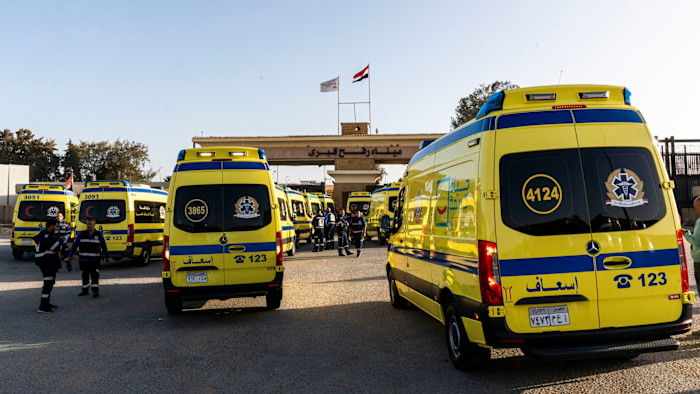

Stay informed with free updates
Simply sign up to the Middle Eastern politics & society myFT Digest — delivered directly to your inbox.
Israel is preparing to allow pedestrian traffic through Gaza’s Rafah crossing with Egypt from Monday, in a partial restoration of the Palestinian territory’s sole gateway with the wider world.
The limited reopening follows a fragile ceasefire between Israel and Hamas in the Palestinian territory that began in October. The crossing has been largely closed, apart from a few weeks in 2025, since May 2024, when Israel’s army seized the Rafah region and border with Egypt.
Israel has said only Palestinians travelling on foot will be allowed to enter and exit, meaning the crossing will not be used to bring aid into Gaza, as it was in the past. Humanitarian provision via the enclave’s crossings with Israel has increased since the ceasefire, though officials say the quantities are not enough for the war-ravaged territory and its hungry population.
Cogat, the Israeli military body that co-ordinates Palestinian civilian affairs, said “a pilot was under way [on Sunday] to test and assess the operation of the crossing” and that passage would start on Monday.
TV footage from the Egyptian side of the crossing on Sunday showed dozens of ambulances waiting to evacuate injured and sick Palestinians for treatment abroad. Some 18,500 Gazans are on lists waiting to travel for medical help.
Israel has said it will allow only those whose names it has approved in advance to cross in both directions, while Egypt also plans to vet and approve lists of those wishing to enter its territory.
Israeli forces remain on the border with Egypt and in Rafah governorate, which they have designated part of a security perimeter within the strip. They will not be stationed at the crossing but will conduct checks on Palestinians entering Gaza at a checkpoint inside the border. EU monitors have been deployed to supervise operations inside the crossing.
Israel has largely barred Palestinians from entering or leaving Gaza since it launched its assault on the strip following Hamas’s October 7 2023, attack on Israel, though in the war’s early months limited numbers of Palestinians were able to leave through Rafah.
The ceasefire deal brokered by US President Donald Trump had envisaged Rafah opening in its first phase, but Israel delayed the crossing’s reopening until Hamas returned the remains of the final Israeli hostage held in Gaza.
Last week, Israel repatriated the body of Ran Gvili, paving the way for the second phase of the ceasefire plan, which is intended to include the disarming of Hamas, the entry into Gaza of an international stabilisation force, and a withdrawal by Israeli troops — who currently occupy more than half the territory — to a buffer zone.
A body of Palestinian technocrats announced in recent days is also due to take over day-to-day governance of Gaza from Hamas. But the group is still based in Egypt and Israel has not specified when they will be allowed into the enclave.
Israel and Hamas have been exchanging accusations of ceasefire violations since the agreement came into force. Israeli strikes have killed 520 Palestinians since the ceasefire, including 30 on Saturday, according to health officials in the strip, who said that about 100 children were among the fatalities.
On Sunday, a group of Arab and Islamic countries including Egypt, Jordan, Turkey, the UAE, Qatar and Saudi Arabia issued a joint condemnation of “Israel’s repeated violations of the ceasefire in Gaza”. They said these had hindered “efforts to create appropriate conditions for transitioning to a more stable phase in Gaza”.
Read the full article here