


 English
 Français
 Deutsch
 Italiano
 Português
 Русский
 Español
 简体中文
简体中文 日本語
日本語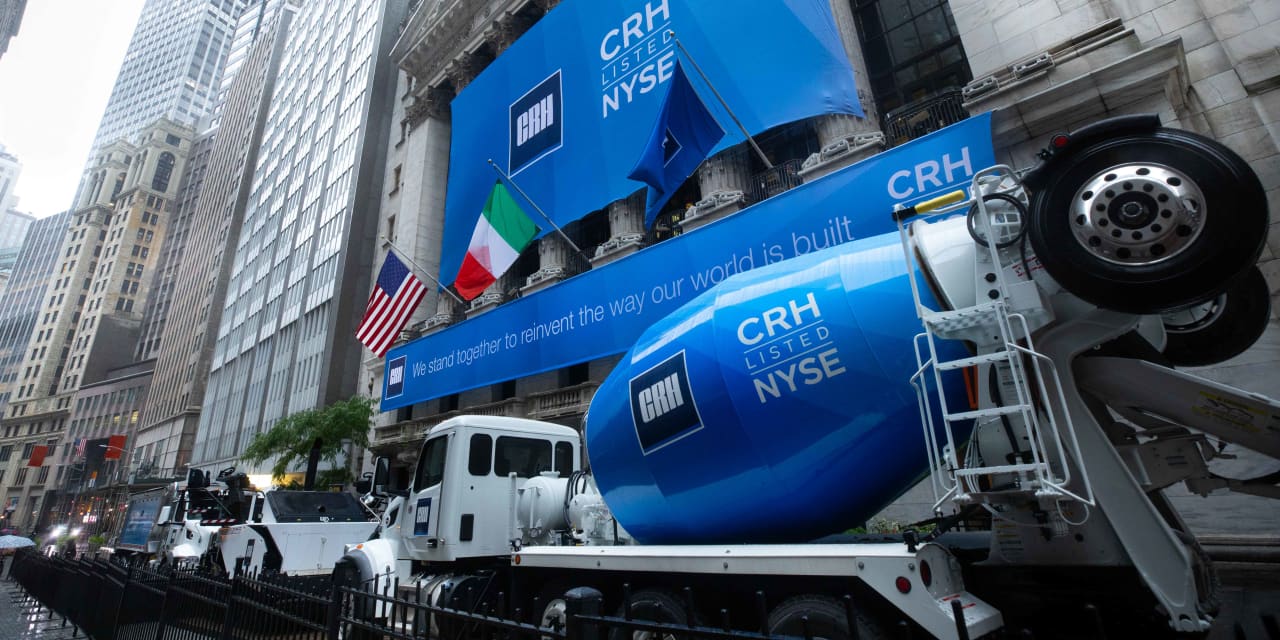

Construction-solutions provider
CRH
is a brand-new American company. That was part of the plan to create more shareholder value.
CRH (ticker: CRH), which began life in the 1970s, had its CEO Albert Manifold ring the opening bell at the New York Stock Exchange on Monday, celebrating the company’s move of its primary stock listing to the U.S. from Europe.
“Today marks an important milestone in CRH’s development which will enable us to fully participate in the significant growth opportunities that lie ahead for our business,” said Manifold in a news release.
There are several reasons for the change. For starters, the company generates about three-quarters of its profits from North America. CRH is actually the largest building-materials provider in the country.
U.S. investors might not realize that, though. It was treated by the Street like a European company, with EU-based analysts covering the stock. That will change over time with the new listing. That’s another reason for the change: More exposure to U.S. investors.
It seems odd that a listing can change the fortunes of a stock, but consider CRH stock’s trading volume has soared tenfold year over year to about 6.5 million shares in the last 20 days.
More U.S. trading volume means American institutional investors can start looking at CRH stock. A mutual-fund manager allocating billions of dollars simply can’t buy or sell a stock if it trades $30 million dollars of value a day—a measurement of stock price times volume. CRH is now trading closer to $350 million a day. Volume should continue to improve with the new primary listing.
Barron’s wrote positively about CRH stock in May, believing that more infrastructure spending in the U.S. would translate into faster earnings growth. We also believe that putting its primary listing on the New York Stock Exchange could help improve the stock’s valuation multiple. CRH stock trades for about 12 times estimated 2024 earnings. A similar business,
Vulcan Materials
(VMC), trades for about 24 times.
There isn’t a significant difference between growth, margins, and markets for the two companies. Both are U.S. materials providers. Vulcan’s operating profit margins are around 18% and earnings are projected to grow about 7% a year on average for coming three years, according to FactSet. CRH earnings are forecast by the Street to grow close to 9% a year on average.
Comparable profit margins at CRH are about 13%, but CRH does more construction-services business. Manifold says that his company’s margins in comparable materials businesses are similar to peers, adding, “We have higher levels of absolute profitability” at an analyst event in midtown Manhattan that will introduce the company to more U.S. investors.
CRH’s total operating profit in 2024 is projected to be about $4.6 billion, compared with Vulcan at $1.6 billion.
Since our May article on CRH stock appeared, shares are up about 12%, while the
S&P 500
is up about 3%. It’s nice to have a solid start after recommending a stock. There is no reason to take profits yet. The CRH story is still in its early chapters.
CRH stock is up about 2.3% in midday trading on Monday. The S&P 500 and
Dow Jones Industrial Average
are up about 0.3% and 0.1%, respectively.
Write to Al Root at [email protected]
Read the full article here